Architecturally appealing monumental stairs can often translate into structurally flexible systems. Walking or running on such stairs may cause annoying vibrations. We have provided vibration design services for numerous monumental stairs with great success. We start by building a 3-D finite element model of the stair along with the structural floor framing that supports it. Next, we perform vibration analyses to uncover an optimal stair design that will meet established vibration criteria and also mitigate any adverse effect of vibrations on floor occupants.
A monumental stair spanning between two floors was designed without intermediate vertical supports. The stair was supported by cantilevered structures at both ends, resulting in relatively flexible boundary conditions. This configuration led to a “lively” structure prone to vibration from pedestrian activity.
The base design vibration criterion was established in accordance with recommendations from the American Institute of Steel Construction Design Guide 11 to ensure occupant comfort.
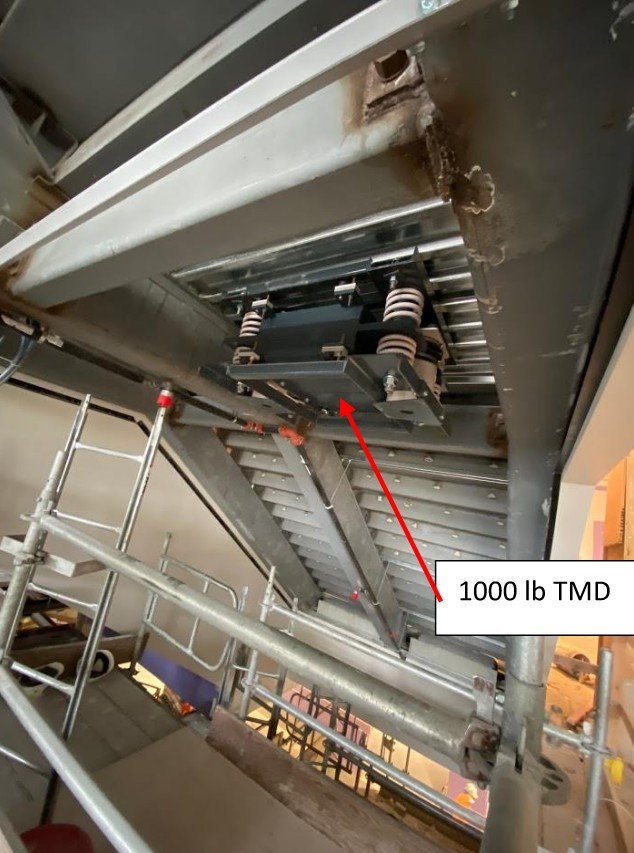
A detailed finite element model of the stair and its supporting floor structures was developed to perform advanced vibration analysis and guide the structural design. The analysis indicated that increasing stiffness alone would not significantly reduce vibration levels due to the flexibility of the supports. Instead, the design incorporated a tuned mass damper (TMD) as a supplemental damping solution to achieve the required performance.
Pre-installation testing confirmed that vibration levels exceeded the target criteria, consistent with analytical predictions. Following fabrication and installation of the TMD beneath the stair landing, post-installation testing demonstrated that vibration levels were successfully reduced to meet the established comfort criteria.
The tenant desired to connect three floors through an elegant, spiral stair. Given the complex geometry of the stair, it was constructed from steel plates. The vibration design task was to construct a 3-D finite element model of the stair, including the connections to the floors, and to perform footfall vibration analysis. The required plate sizes were designed per the vibration analysis.
Maximum peak acceleration was selected as the monumental stair vibration criteria following the recommendations of the American Institute for Steel Construction, Design Guide – 11.
A finite element model (FEM) of the stair was built and enhanced vibration analyses were conducted with consideration for people ascending/descending the stair.
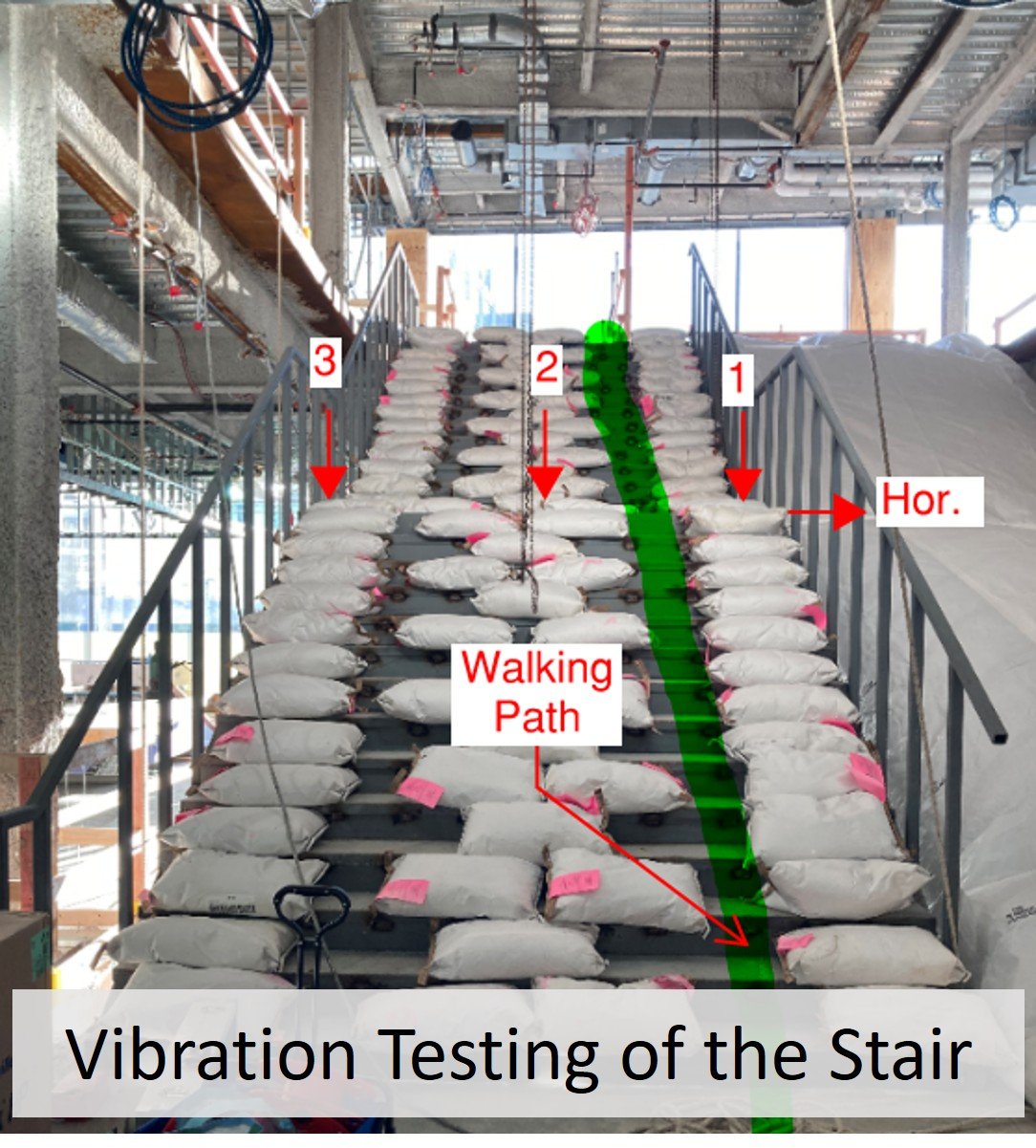
Optimum plate sizes were determined while keeping the vibration levels below acceptable levels. Just before the construction was complete, a quick vibration test opportunity was obtained. Measurements indicated that the model’s frequency estimate was within 1% of the measured stair frequency. Moreover, ascent/descent tests on the stair confirmed the estimated vibration levels per our detailed FEM.
The Mass General Brigham project included multiple monumental stairs. We highlight only the one with over 36 feet diagonal span supported by two side stringer beams.
Maximum peak acceleration was selected as monumental stair vibration criteria following the recommendations of the American Institute for Steel Construction.
A detailed finite element model of the stair was built and enhanced vibration analysis was conducted with consideration for both normal and rapid descents.
Steel framing was efficiently updated to meet required vibration performance goals.
For inquiries about Vibration Consulting, please use this email form to contact Dr. Omer Tigli.